
Designing the Máni Moon Mission: Our Engineering Insights and Lessons from Phase A
Welcome to this month’s Lightbulb Moment, where senior systems engineer Matija Herceg shares some of the engineering insights and hard-earned lessons from the Máni mission as it accelerates into Phase A – and how aiming for the Moon is pushing our technology to new heights.
Lesson #2
The Máni lunar mission is progressing through Phase A, with Space Inventor leading the spacecraft platform development and carrying out key mission design activities needed to turn the mission concept into a feasible lunar mission. At this stage, our work focuses on understanding how Máni can travel from Earth to the Moon, enter and maintain its operational lunar orbit, and perform its mission using the capabilities of the Big Cat 600 spacecraft platform.
A major part of this work is the Earth-to-Moon transfer design. Reaching the Moon is considerably more complex than simply targeting its position in space. The launch date, departure geometry, transfer duration, spacecraft propulsion capability, and arrival conditions all influence the amount of propellant required and the conditions under which the spacecraft reaches the Moon.
For Máni, we’re analysing a range of possible launch opportunities and transfer trajectories rather than relying on a single reference case. For 2029 alone, 23 candidate launch opportunities have been analysed, covering transfer geometries in both the second and fourth quadrants. The figure below illustrates these trajectories and shows how significantly the geometry of an Earth-to-Moon transfer can change depending on the launch opportunity.
Watch how the Máni mission will operate in a polar orbit to deliver the first-ever ultra-high-resolution mapping of the lunar surface.
This analysis allows us to compare transfer duration, spacecraft manoeuvres, and lunar arrival conditions, and to understand how flexible the spacecraft design needs to be. As the mission and launch interface mature, the trajectory analysis will narrow down to a smaller set of preferred launch windows and transfer solutions.
Reaching the Moon is, however, only part of the problem. Once Máni arrives, the spacecraft needs to enter an orbit that enables its scientific observations while remaining compatible with propulsion, communication, power and operational constraints.
Detailed lunar orbit analysis is therefore another major activity during Phase A. Space Inventor is studying the mid-term evolution of candidate lunar orbits to understand their stability and to determine how frequently orbital correction manoeuvres may be required. At approximately 75 km altitude, variation in lunar gravity field causes the orbit to evolve over just a few weeks, requiring regular station keeping maneuvers every 2-4 weeks to keep the operational orbit. The orbit-maintenance manoeuvres are optimised to minimise ΔV while keeping key orbital parameters, such as altitude, eccentricity, and inclination, within predefined operational thresholds throughout the mission.
Máni is also an important step in the development of Space Inventor's Big Cat 600 platform for deep-space missions. Operating around the Moon introduces challenges significantly beyond those encountered in conventional Earth-orbiting missions. Propulsion, electrical power, thermal control, communications, navigation, and spacecraft autonomy must all work together in an environment where real-time intervention from the ground cannot always be assumed.
Lightbulb Moments: Key Takeaway
The Phase A mission analysis connects trajectory and orbit design directly with spacecraft system engineering. By evaluating the mission and spacecraft as an integrated system, we can identify critical design drivers early and refine both the Máni mission architecture and the Big Cat 600 platform.
Over the coming phases, these analyses will be refined as launch opportunities, spacecraft configuration, propulsion performance, and operational requirements mature - progressively transforming Máni from a mission concept into a robust lunar mission design.
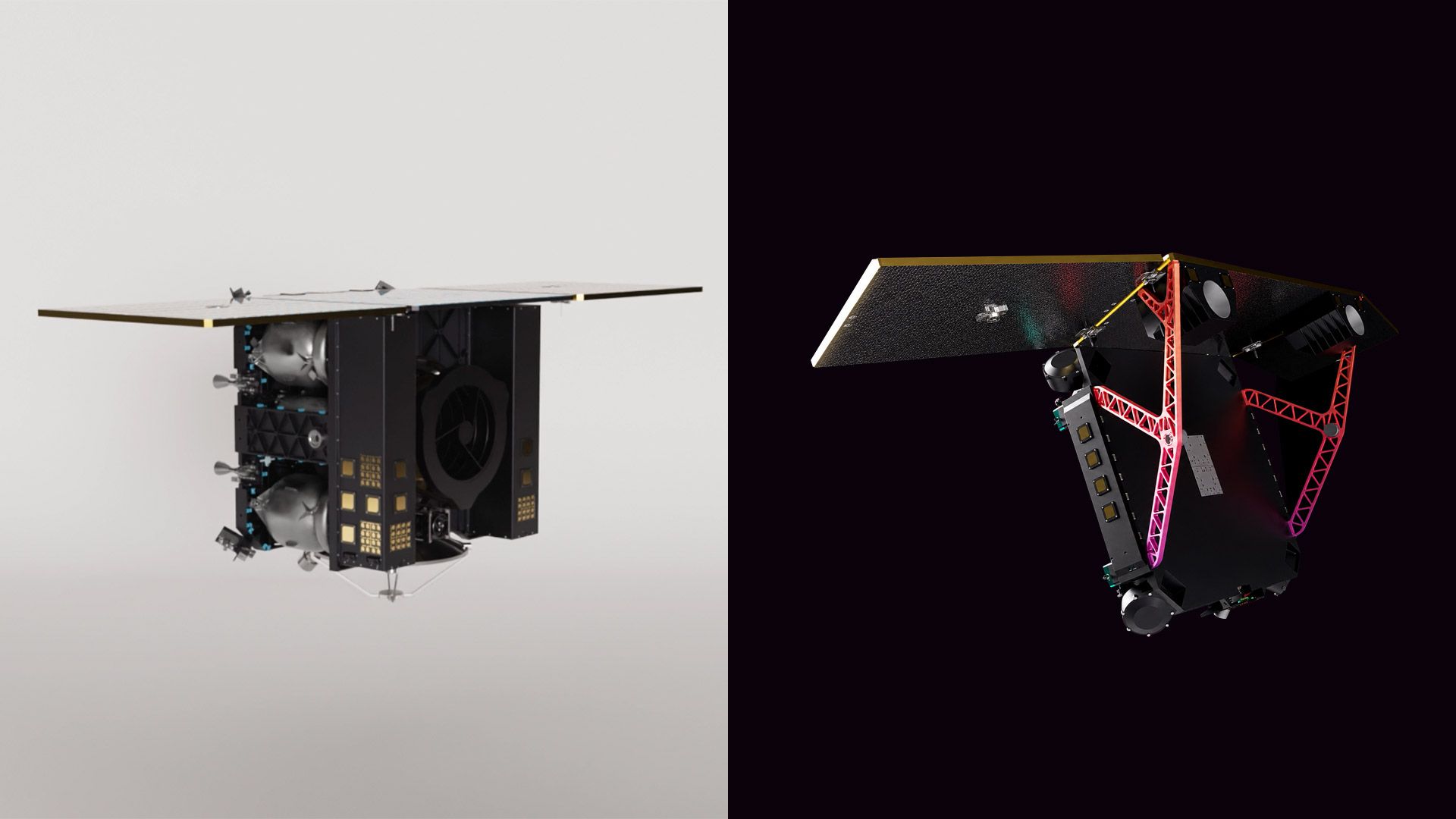
Left: current design of the MÁNI satellite. Right: Space Inventor's BC600 platform, which MÁNI will migrate to.
Popular articles